


Looking for the right podcast platform but not sure where to start?
The market is filled with options that can make you overwhelmed. While some creators want an all-in-one platform with built-in live streaming and monetization. Others care more about analytics, growth, and managing multiple shows. And then there are creators who already have valuable content but struggle to get their audience to actually listen.
In this post, we’ll break down two of the most popular public podcast hosting platforms, Podbean and Captivate, compare their features, pricing, and ideal users.
Whether you’re launching a new show or growing an existing podcast, this guide will help you determine which platform best fits your needs.
TL;DR – Podbean vs Captivate
Here’s a quick snapshot comparing Podbean and Captivate, highlighting what each platform offers, who it’s best for, and how they differ:
| A comprehensive podcast platform that supports public shows with hosting, distribution, and analytics. | Growth-focused podcast hosting platform built for analytics, planning, and long-term scale |
| - Supports both audio and video podcasts - Built-in monetization options like ads, premium content, and listener support - Live streaming for real-time audience engagement - Easy setup and minimal learning curve | - All features included on every plan - Strong focus on analytics and growth insights - Unlimited podcasts and team members - Clean, well-guided dashboard |
| - Interface can feel dated at times - Some advanced features are locked behind higher plans - Additional fees for add-ons like transcription | - No built-in recording or editing tools - Pricing scales based on download limits - Some monetization features are still evolving |
| Creators who want an all-in-one podcasting solution with built-in monetization, live streaming, and minimal reliance on external tools | Podcasters focused on growth, analytics, and managing multiple public shows with an existing production workflow |
While Podbean and Captivate focus on public podcast growth and monetization, creators with existing content often face a different challenge: getting their audience to actually listen.
Hello Audio takes a different approach; instead of focusing on charts or downloads, we deliver content through private podcast feeds, making it easy for creators to repurpose courses, coaching calls, or membership material into an audio experience their audience can access anywhere.
What is Podbean?
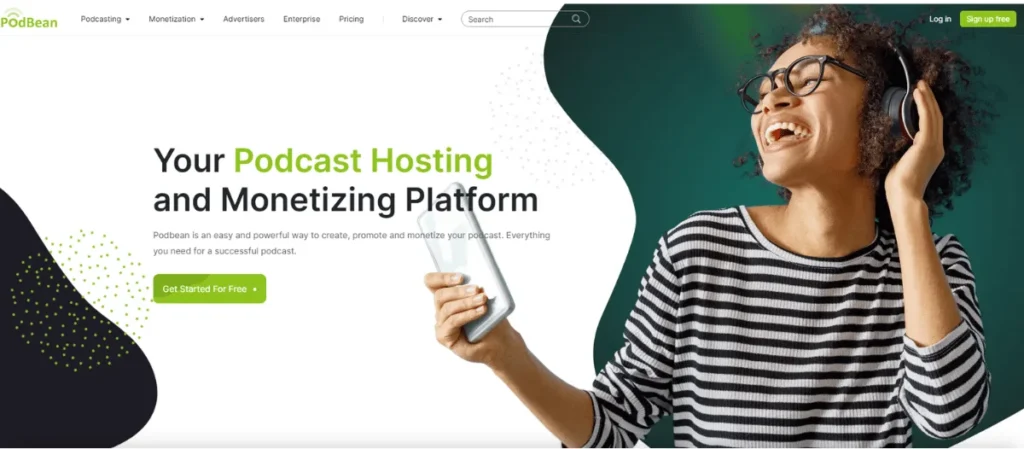
Podbean is a long-established podcast hosting platform that lets creators publish, distribute, promote, and monetize podcasts from one dashboard.
It supports both audio and video podcasts, live streaming, and private shows, and automatically distributes episodes to major platforms like Apple Podcasts and Spotify.
Podbean is designed as an all-in-one solution for creators who want everything in one place without a complex setup.
Podbean Features
Podbean offers tools for both beginners and experienced podcasters, focusing on usability, distribution, engagement, and monetization.
Key features include:
- Automatic distribution: Episodes are automatically sent to Apple Podcasts, Spotify, Google Podcasts, YouTube, and other major directories.
- Live audio streaming: Connect with listeners in real time through live sessions, Q&As, or interactive events.
- Remote recording via mobile app: Record with up to 7 co-hosts or guests, with recordings saved automatically for easy editing.
- Built-in editing tools: You don’t have to leave the platform to do basic editing. There are tools that will help you trim clips, stitch recordings, and add music or intros.
- Automated transcription & captions: There are optional add-ons for better accessibility and content repurposing.
- IAB-certified analytics: Track downloads, listener locations, and engagement using industry-standard metrics.
- Custom podcast websites: Every podcast gets a website that can be branded, customized, and connected to your own domain.
- Embeddable media players: Share episodes or playlists on blogs, landing pages, or other platforms.
- Promotion tools: Automatically share episodes on social media or via email through Mailchimp.
- Monetization options: You can make money on the platform via ads, premium content, and listener support. There’s a Patron Program as well.
- Private podcasts for businesses: Manage access, multiple admins, and remove Podbean branding for internal teams or gated content.
Podbean Pricing
Podbean offers a wide range of plans that let you start small and scale up as your podcast grows:
- Basic Plan – Free: This plan is designed for getting started or experimenting with podcasting before committing to a paid platform.
- Unlimited Audio – $12/month (billed annually): This is Podbean’s most popular plan, and where the platform starts to feel truly unlimited.
- Unlimited Plus – $29/month (billed annually): The Plus plan opens up video support and adds more upload capacity. It’s a sweet spot for creators who want to mix audio and video.
- Network – $79/month (billed annually) or $99/month (billed monthly): Podbean’s Network tier is ideal if you manage multiple public podcasts under one umbrella, like a branded network or media group.
- Business Plan – $99/month (billed annually): This plan is aimed at organizations and teams that need more control, privacy, and collaboration features.
Podbean Reviews
When you check out Podbean reviews across multiple platforms, a clear picture emerges: it’s a solid, beginner-friendly podcast host, but it has a few quirks that matter depending on your needs.
On average, Podbean scores around 4 out of 5 stars on platforms like G2 or Software Advice. Users like that it is easy to use, offers reliable hosting, and has built-in distribution. For many beginners, it’s exactly the tool that gets a podcast live without headaches.
What Users Like
- Ease of publishing: Uploading, distributing, and sharing episodes is straightforward. Even if you’re a beginner, you can get started without a steep learning curve.
- Automatic distribution: It syndicates episodes to major directories, such as Apple Podcasts and Spotify, so they reach listeners quickly.
- Analytics that make sense: The IAB-certified stats are simple to read and interpret, helping you understand downloads, engagement rate, and which audience demographic you’re connecting with.
- Reliability: The episodes generally stay live and propagate really quickly, giving you the confidence that your audience can access content at any time of the day.
Common Critiques
- Customer support: Some users report that support can be slow or unhelpful when they encounter technical issues.
- Interface feels dated:While Podbean’s dashboard is functional, you might find it a little outdated compared to some of the newer hosting platforms out there, especially for multi-show management.
- Limitations on lower tiers: Lower-tier plans don’t include all the tools, so new creators might need to upgrade sooner than expected.
- Technical quirks: Occasional artwork or feed issues are reported, mostly when distributing to multiple platforms.
What is Captivate?
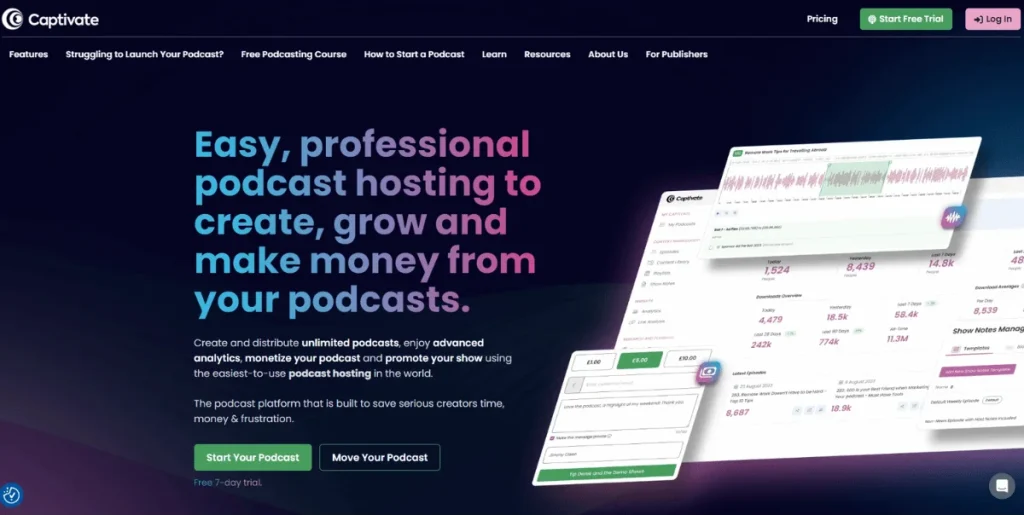
Captivate is a podcast hosting and management platform built for podcasters who want a simple, growth-focused way to publish and manage their shows.
Created by the team behind Rebel Base Media and Podcast Websites, it focuses on hosting, distribution, analytics, and promotion, with all features included on every plan and pricing based only on monthly download limits.
Captivate Features
Captivate focuses heavily on growth, analytics, and workflow efficiency. The platform is designed to support podcasters before, during, and after publishing.
Some of Captivate’s standout features include:
- Single-click distribution: Submit your podcast to Apple Podcasts, Spotify, Amazon Music, and more with one click, plus get a clean RSS feed for subscribers.
- Unlimited podcasts & storage: Host unlimited shows, upload freely, and add unlimited team members (download limits apply).
- Advanced monetization: Support listener tips, memberships, exclusive content, early access episodes, and bonus content.
- IAB-certified analytics: Track downloads, listener locations, devices, click-through rates, and episode performance.
- Captivate sites: Every plan includes a no-code podcast website with custom domains, SEO tools, email signups, and social sharing.
- Planning & guest management: Built-in episode planning, idea tracking, and guest booking tools streamline production.
- Third-party integrations: Connect with Descript, Zapier, Podchaser, Mailchimp, AWeber, Squadcast, and more.
Captivate Pricing
Captivate uses a very simple pricing model: all features stay the same across plans, and download limits are the only difference.
Here’s how the pricing breaks down:
- Personal Plan – $17/month (billed annually): If you’re a solo creator or a small podcast host who wants room to grow, then this plan is just for you.
- Professional Plan – $44/month: Designed for growing podcasts with larger audiences or multiple shows.
- Business Plan – $90/month: Best suited for podcast networks, agencies, or client-based podcasting.
Captivate Reviews
Podcasters generally speak well of Captivate, especially for its usability and transparency. Many users note that it feels approachable rather than overwhelming, even early on.
What Users Like:
- Their dashboard is mostly clean, intuitive, and easy for someone new to navigate.
- They offer onboarding tutorials and in-app guidance, making the entire setup feel a lot simpler.
- Their analytics are very detailed as well as easy to understand, without forcing upgrades.
- Unlimited podcasts, storage, and team members offer strong long-term value.
- Support is often described as responsive and genuinely helpful.
Common Criticisms:
- Download-based pricing can become expensive as a podcast scales.
- Monetization tools are still evolving, with some features remaining in beta.
- No built-in audio recording or editing tools, which means relying on third-party software.
What About Hello Audio?
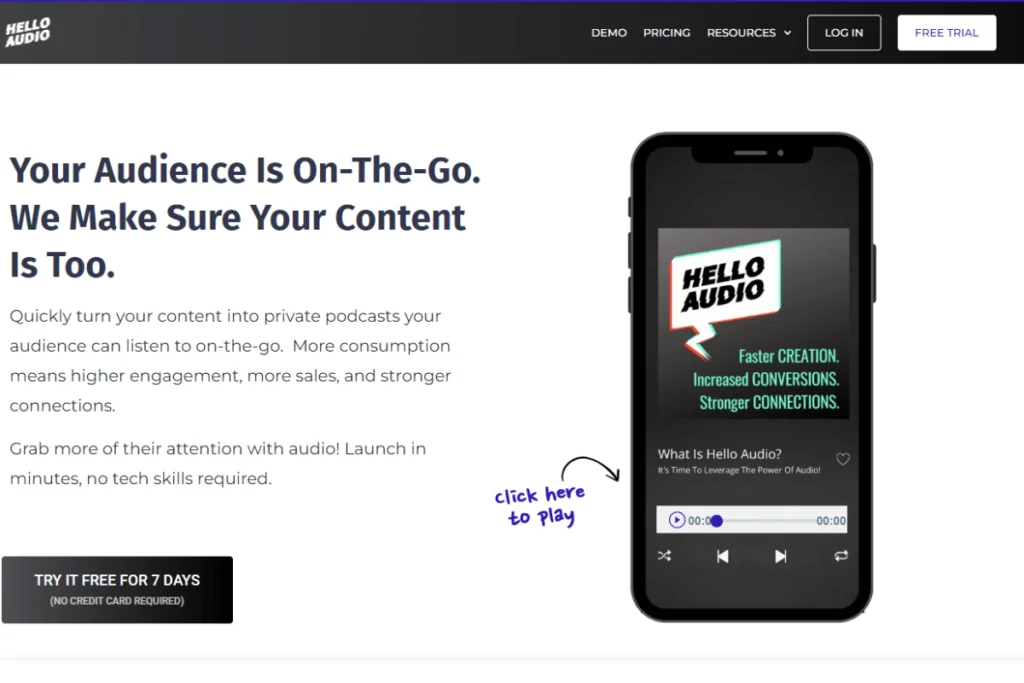
Hello Audio is a podcast hosting platform that is designed to help creators turn existing content into audio that people actually listen to. Unlike Podbean or Captivate, it focuses on private feeds and making content easy to consume for specific audiences.
At its core, Hello Audio lets you upload audio or video files and deliver them as private podcast feeds that your audience can subscribe to in the podcast apps they already use. No logins, no downloads, just seamless access.
Key features include:
- Private distribution: Control who gets access to each feed.
- Audio from any content: Convert courses, coaching calls, webinars, or event recordings into consumable audio.
- Flexible listening: Audience can listen anytime, anywhere, on apps they already use.
Where Hello Audio shines is in helping audiences actually finish your content. It doesn’t replace your existing hosting setup; it makes your content more engaging and easier to consume on the go.
Sign up with Hello Audio today.
Benefits of Using Hello Audio
Here’s why creators choose our tool and what it does particularly well:
Turn Existing Content into Private Podcasts
You can upload video, audio, or other media files, and Hello Audio converts them into audio feeds that listeners can access through their favorite podcast apps.
Designed for Private Distribution
Unlike most podcast hosting platforms, which focus on public shows, our specialty is delivering private feeds to specific people.
You control exactly who gets access and how they receive it, whether that’s clients, students, members, or event attendees.
Go Beyond Static Content
Instead of PDFs, videos, or email series that people skim or ignore, Hello Audio gives your audience a way to listen, which matters when people are commuting, walking, working out, or doing chores.
That’s how it actually boosts consumption and engagement.
Easy for Listeners
Your audience doesn’t need to invest in a new app or platform. With Hello Audio, they get a private RSS link and subscribe to it in any podcast player they already use.
That simplicity removes a huge adoption barrier.
Listener Management and Personalization
You can tag listeners, control access to each episode, and even automate actions based on how the audience interacts with your content.
This is what makes our platform feel less like a simple host and more like a lightweight CRM for audio experiences.
Feed Flexibility
Hello Audio supports more than just chronological episode lists.
You can create dripped or expiring feeds, which let you pace content delivery or automatically revoke access after a set time, useful for courses or gated programs.
Video-to-Audio Conversion and Bulk Uploads
Instead of manually extracting audio from video, just upload your files and let Hello Audio do it for you.
Bulk uploads let you convert large libraries of content into audio feeds in minutes.
Integrations and Workflow Support
Our platform works with tools like Zapier and major email and CRM systems, so you can automate listener additions, notifications, and more without switching platforms.
Relevant Characteristics Between Podbean and Captivate
Before choosing a platform, it helps to look at what each one is actually designed to do. Podbean, Captivate, and Hello Audio all support audio delivery, but they serve different goals and types of creators.
Let’s break down the most relevant characteristics side by side:
| Primary Use Case | Public podcast hosting with built-in monetization and live features | Growth-focused podcast hosting for public shows | Private audio delivery and content repurposing |
| Public Podcast Distribution | Yes, automatic distribution to all major directories | Yes, with single-click submission | Not the focus; designed for private feeds |
| Private Podcasting | Available on higher-tier business plans | Available across plans (with subscriber limits) | Core feature, built around private access |
| Content Type Supported | Audio and video podcasts | Audio podcasts | Audio and video converted into audio |
| Recording & Editing Tools | Built-in recording, live streaming, and editing | Integrates with external creation tools | Focuses on delivery rather than creation |
| Monetization approach | Ads, listener support, premium content | Memberships, tips, and bonus content | Pairs easily with existing sales and payment systems |
| Analytics & Insights | IAB-certified download and audience data | Advanced IAB analytics with growth insights | Listener access and engagement-level control |
| Audience Engagement | Tools for managing listeners and engagement | Unlimited team access and podcast networks | Granular control over listeners and access |
| Best Suited for | Creators launching and monetizing public podcasts | Podcasts focused on long-term growth and analytics | Educators, coaches, and businesses delivering gated audio experiences |
Similarities and Differences
At a glance, Podbean and Captivate can look very similar. However, they also have certain different functionalities.
Let’s look at both:
Podbean and Captivate Differences
These differences show up in how each platform approaches creation, monetization, and day-to-day podcast management:
- All-in-one vs focused hosting: Podbean aims to cover the full podcast lifecycle, including recording, editing, live streaming, monetization, and distribution. Captivate focuses on hosting, publishing, analytics, and promotion, assuming you already have creation tools in place.
- Built-in creation tools: Podbean has built-in mobile recording and editing features, as well as live audio streaming. Whereas Captivate does not offer recording or editing tools, it integrates with third-party platforms for production.
- Approach to monetization: Podbean offers multiple built-in monetization options, including ads, premium podcasts, and listener support. Captivate focuses more on memberships, tips, and listener-supported models, with some monetization features still evolving.
- Pricing structure: Podbean tiers plans based on features and usage. Captivate gives access to all features across all plans, with pricing determined solely by monthly download limits.
- Use case flexibility: Podbean works well for creators who want everything in one place, including live engagement and video. Captivate appeals to podcasters who prioritize planning, analytics, and long-term growth over production tools.
Podbean and Captivate Similarities
Despite taking different approaches, Podbean and Captivate share a strong core. Both platforms cover the essentials of hosting, distribution, and analytics that most public podcasters rely on.
Other similarities include:
- Public podcast hosting and distribution: Both platforms handle hosting and automatically distribute podcasts to major directories like Apple Podcasts, Spotify, and Amazon Music.
- IAB-certified analytics: Podbean and Captivate both offer industry-standard analytics that provide accurate insights about your downloads and listener behavior.
- Podcast websites and embeddable players: Each platform includes a podcast website and customizable media players that can be embedded across websites and marketing pages.
- Support for multiple podcasts: Both platforms allow creators to manage more than one show under a single account, making them suitable for networks or growing portfolios.
- Tools designed to support growth: Whether through monetization options, marketing tools, or analytics, both Podbean and Captivate are built to help podcasters grow their audience and understand performance over time.
The Bottom Line
Choosing between Podbean and Captivate comes down to how you want to manage and grow your podcast.
You should choose Podbean if you want an all-in-one platform that offers live streaming, monetization, and minimal setup. Turn towards Captivate if you value analytics, workflow, and long-term growth across multiple shows.
But if your goal isn’t just counting downloads, and you want your existing content to be consumed, Hello Audio offers a fresh approach. By converting your audio and video into private podcast feeds, we make the content easy to access, boost engagement, and fit seamlessly into your audience’s listening habits.
Sign up with Hello Audio if you’re focused on impact over charts.

Frequently Asked Questions (FAQs)
Before wrapping up, here are a few common questions that come up when comparing Podbean and Captivate, along with straightforward answers to help clarify the details:
Are Both Platforms Suitable for Podcast Networks?
Yes. Podbean supports podcast networks through its higher-tier and business plans, making it suitable for teams and organizations managing multiple shows.
Captivate also supports multiple podcasts under one account and includes network-friendly tools across all plans.
Can I Use My Own Domain With Podbean or Captivate?
Both platforms allow you to connect a custom domain to your podcast website on paid plans.
This helps maintain consistent branding and gives you a more professional web presence for your show.
Can I Add Custom Branding to the Podcast Player?
Yes. Podbean and Captivate both offer embeddable podcast players that can be customized to match your brand, including colors and layout options, depending on your plan.
Is There a Free Trial for Podbean or Captivate?
Podbean offers a free plan with limited storage and features, which is useful for testing the platform.
Captivate provides a 30-day free trial with full access to its features before you commit.