

If you sell courses or run a coaching program, you may have seen people fall behind once the videos start piling up.
So what can you do? You can turn your content into audio. Now it fits into their daily routine, and they can keep up anywhere. And it works. 40% of the time spent listening to spoken-word is now spent with podcasts.
But the moment your content becomes portable, it also becomes easier to share and access without control.
This guide shows how to deliver exclusive audio while keeping it convenient for your audience and protected for your business.
Why Secure Audio Delivery Matters for Your Business
Most people don’t think about audio delivery until something goes wrong.
A customer shares a link, someone who shouldn’t have access still does, or content that was meant to feel premium ends up feeling very easy to share with others.
The way your audio is delivered directly impacts how it’s used and how much control you actually have as your audience grows.
Let’s dive into why secure delivery matters:
Preventing Unauthorized Access and Sharing
When access is just a link or a file, it doesn’t stay private for long. People share it. It gets forwarded, reused, or ends up in some shared folder.
And these things don’t always stay small. IBM puts the average cost of a data breach at $4.88 million, underscoring how quickly weak access points can escalate into bigger issues.
Secure delivery is what keeps it from getting out of hand.
Structuring Access for Paid and Private Content
With secure delivery, you control access. You get to decide who gets it, when they get it, and when it is supposed to end. If this structure is missing, then things are bound to drift. People keep accessing longer than they should, or everything becomes available too soon.
There’s also a security side to this. Verizon’s DBIR found that 22% of breaches start with credential abuse, so how access is managed really does matter.
Protecting Business Value and Audience Trust
Secure delivery makes paid content feel worth the money. If it’s easy to share, people treat it that way. When access is controlled, the value holds.
It also affects trust more than people realize. When access feels exclusive, it reflects well on your business. When it feels loose, that shows too.

Security Threats to Exclusive Audio Content
There are a few threats that come with exclusive audio content. The tricky part is that you may not always see them until something goes wrong.
Here are the ones that matter most:
- Stream ripping and unauthorized recording: Even when audio is delivered through a controlled podcast platform, it can still be captured while playing. Once recorded, it can be redistributed without any control.
- Credential sharing and unauthorized access: Access often depends on login credentials. When those credentials are shared, reused, or compromised, people outside your intended audience can get in without paying or being approved.
- Link sharing and uncontrolled distribution: If access is tied to a static or reusable link, it only takes one share for that link to spread. From there, it becomes difficult to track or limit who is actually listening.
- Network traffic interception: When audio is delivered without proper encryption, data can be exposed during transmission. This can lead to illegal access to both the content and listener information.
- API misuse and automated scraping: Automated tools can interact directly with backend systems to pull content or data in bulk. This bypasses normal user access points and makes it harder to control distribution.
- Voice cloning and audio manipulation: Audio content can be used to generate synthetic voice outputs that mimic the original speaker. This creates risks around misuse, impersonation, and loss of control over how your content is represented.
That risk hits harder because of how people react to audio. As Reddit user Relative-Strategy744 put it:
“That’s actually terrifying when you think about how many people still trust voicemails way more than texts or emails.”
Business Use Cases for Secure Audio Content
Having a secure audio makes the most sense when the content is not meant for the public. That’s why it’s most common in businesses where access, convenience, and control matter simultaneously.
Best use cases are:
Online Courses
A lot of course creators turn lessons into audio so people can keep up without sitting in front of a screen. It’s more flexible, and people are more likely to actually finish the content.
But it’s still paid content, so it shouldn’t be easy to pass around beyond the people who bought it. Also, keeping the content secure ensures that it stays exclusive and isn’t misused.
Employee Training
Instead of long documents or video-heavy modules, teams can listen to training while getting through their day. It works well for onboarding and regular updates, as long as it stays within the company.
If it’s not controlled, internal training can easily end up outside the organization.
Membership Programs
Members expect something they can’t get elsewhere. Audio works well for that, whether it’s updates, exclusive series, or ongoing content.
Keeping it limited to active members is what makes it feel worth paying for. If it’s easy to access without membership, that sense of exclusivity fades quickly.
Coaching Programs
Coaches often end up with a lot of valuable content, like calls, training, and walkthroughs. Turning that into private audio gives clients something they can revisit without having to dig through files or dashboards.
Without proper access control, that client-only content can easily be passed around.
Internal Communication
For businesses with distributed teams, audio can make it easier to stay up to date on updates. Audio can be an effective internal communication strategy for leadership messages, quick briefings, and weekly updates. Information is more likely to get heard when it’s easy to listen to.
If access isn’t restricted, sensitive internal updates can end up in the wrong hands.
Premium Content and Paid Series
Some creators use private audio as a paid offer on its own. Bonus episodes, deep dives, or ad-free content all fit here. The delivery just needs to support that it’s something people paid for.
If it’s not protected, it becomes easy to access without paying, which undercuts the whole offer.
Methods Businesses Use to Deliver Exclusive Audio Content
There’s no single way to deliver exclusive audio. Most businesses start with what’s easy, then switch as they grow and need more control.
A big part of that shift comes down to how the content is experienced. As Reddit user Yelabear put it:
“If the delivery isn’t good, I barely pay any attention to content.”
Here are the most common approaches:
- Direct MP3 downloads: This is the simplest way to do it. After someone signs up or pays, you send them a link to download the audio. The downside is once it’s downloaded, you don’t really have control over where it goes or who it gets shared with.
- Gated content on websites: You can put your audio behind a login or paywall. That works, but it also means people have to log in and click around every time they want to listen, which isn’t always the best experience.
- Premium or subscription podcasts: You can also gate premium audio content and let people access it for a fee through podcast apps. It’s a much smoother listening experience, but how secure it is depends on how you’ve set things up.
- Email-based delivery: Another option is to send audio via email sequences or links. It’s easy to set up, but once emails get forwarded, it can get messy trying to manage who actually has access.
- Branded mobile apps: If you want full control, you can build your own app. That gives you ownership over access and features, but it also takes a lot more time, money, and ongoing maintenance.
- Live audio sessions: You can run live audio sessions, events, or calls. Great for engagement. But once it’s over, it’s harder to control who ends up with the content or how it gets reused.
- Audio courses and private feeds: You can turn your audio into a structured series and deliver it through private feeds or platforms built for it. This usually strikes a better balance between control and a smooth listening experience.
As one Hello Audio customer, Kat Elizabeth, mentions:
“My students are LOVING the audio lessons — learning on the go with no excuses. This is already the most engaged start to a program I’ve ever had!”
Our Favorite Platform to Deliver Exclusive Audio Content to Customers
If you look at the methods above, the pattern is pretty clear. Most options either give you control or convenience.
Which is why you need a platform that offers both, which is Hello Audio.
It’s built specifically for delivering private audio in a way that’s easy for your audience and manageable for you.
Here’s what makes it different:
Private Podcast Feeds with Controlled Access
Instead of sending files or links, you can give each listener their own private feed.
Access is tied to the individual, which makes it much easier to control who gets in and when.
Works Inside Podcast Apps
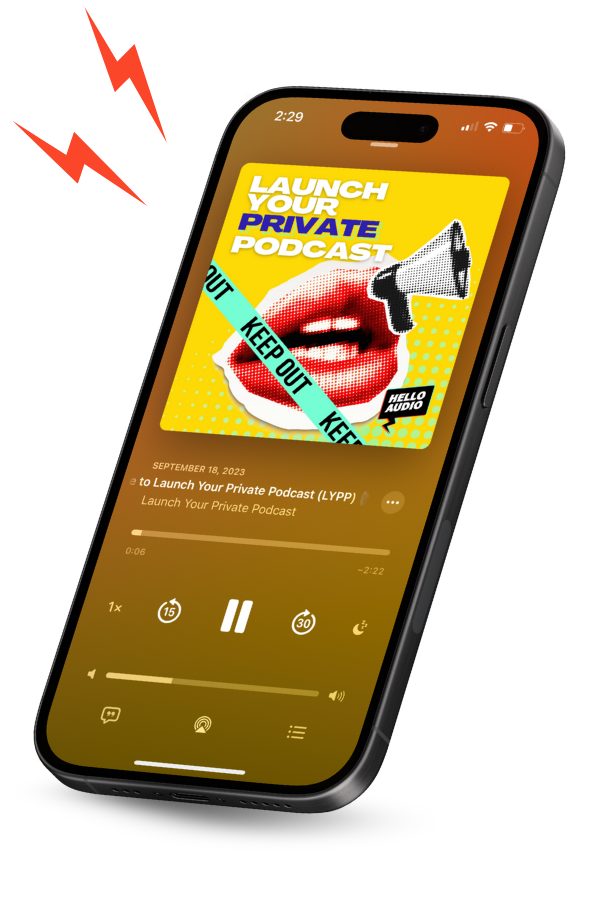
Listeners can access your content in apps they already use, like Apple Podcasts or Spotify. No extra logins, no new platforms to learn.
This alone makes a big difference in how often people actually listen.
Easy Content Repurposing
You can upload video or audio, and Hello Audio converts it into a private podcast feed.
That means you can turn existing content, such as courses, webinars, and recordings, into audio without extra work.
Listener-Level Control
On the platform, you can add or remove listeners at any time.
This feature is especially useful for businesses with memberships, paid programs, or client work where access needs to change over time.
Drip and Expiring Content
You can also release the content over time or set an expiration date.
This helps structure programs, prevent content dumping, and keep access aligned with your offer.
Built-In Automations and Integrations
Hello Audio lets you integrate with tools such as email platforms, payment systems, and CRMs.
This means that you can automate access when someone signs up, purchases, or cancels.
Insights into Listener Behavior
You can see who is listening, what they’re listening to, and how often. This gives you a clearer picture of engagement compared to most other delivery methods.
If you’re looking for a way to deliver exclusive audio without adding complexity, sign up with Hello Audio today.
Best Practices for Maintaining Audio Security
Security is shaped by how you manage access, delivery, and your overall setup over time.
By following these best practices, you keep your content secure:
- Use individual access instead of shared links: One generic link always ends up getting passed around. If you give each person their own access, it becomes much easier to keep things contained.
- Remove access when it’s no longer needed: If someone plans to cancel or finishes their program, they shouldn’t still have access months later. You need access tied to subscriptions or user accounts, so it can be automatically removed when their subscription ends.
- Avoid downloads if exclusivity matters: Downloads are very convenient, but once the file is on someone’s device, it’s out of your hands. Streaming keeps things within your control.
- Don’t unlock everything at once: If all your content is available upfront, it’s easy to download or share in bulk. Releasing it over time slows that down and keeps people engaged.
- Ensure your setup isn’t the weak point: Even if your audio is locked down, gaps in your payment system or integrations can create backdoors. Your systems need to work together so that access is aligned with who actually should have it.
- Monitor listener activity: Look for listening patterns, more than usage. Any sudden spikes, unusual locations, or repeated access across different accounts can signal sharing or misuse.
Frequently Asked Questions (FAQs)
Before wrapping up, let’s quickly go through a few common questions that usually come up around secure audio delivery:
Can Secure Audio Content Support Multiple Languages?
Yes.
You can upload audio in any language you want. Some creators also create separate feeds for different languages, so listeners only see what’s relevant to them.
Can I Offer Audio Content Without a Subscription Model?
Absolutely.
You can offer the audio as a one-time purchase, a part of a course, included in a program, or even shared with a private group. The delivery method just needs to support controlled access.
Which Devices Support Exclusive Audio Content?
Most private audio setups work across major devices, including smartphones, tablets, and desktops.
When delivered via private podcast feeds, listeners can use popular apps like Apple Podcasts, Spotify, Overcast, or Podcast Addict to listen from anywhere.
Conclusion
Exclusive audio works because it fits into people’s lives. They can listen anywhere, stay consistent, and actually finish what they start. The primary challenge is delivering it in a way that keeps that experience intact while still giving you control.
Most setups force you to choose. Either it’s easy to access but hard to control, or it’s secure but frustrating to use.
The better approach is to have both.
That’s exactly what Hello Audio is built for. You can turn your existing content into private podcast feeds, give each listener their own access, automate who gets in and out, and let people listen in the apps they already use.
You don’t need any extra logins, additional links, or trying to find out who still has access.
If you want to deliver exclusive audio without leaks or revenue loss, sign up with Hello Audio.